 OPEN ANDES
The Northern Border in Dispute
I. Opening. The strategic reframing
The Western analytical ecosystem and risk assessment centers assume that the current instability at the northern tip of Chile constitutes a migration crisis combined with a transitory deficit of police control. Under this conventional assumption, the State would simply be facing a deficit of territorial control that could be reversed through legislative adjustments and a greater tactical deployment. This diagnosis is empirically untenable.
The informational contrast that dismantles this narrative reveals a much deeper phenomenon: Chile is not undergoing a simple alteration of public order at its territorial margins, but rather an operational annexation of its land borders by Transnational Organized Crime (TOC). The State is not dealing with isolated criminal gangs that instrumentalize humanitarian chaos; it is losing the monopoly of effective territorial control to corporate criminal networks that have turned the northern boundary into a world-class logistics platform.1
For the foreign observer and the global decision-maker, the image of Chile as the “institutional sanctuary” of the South Pacific must be replaced by an inescapable tactical reality. The country’s borders today operate as a free-transit platform administered de facto by post-state entities. These shadow corporations regulate the flow of narcotics, weapons, and human capital with a level of efficiency, flexibility, and resilience that far exceeds the interdiction capabilities of government customs and security forces.
II. Development. Material inertia and power asymmetry
The physical scenario that accelerates this rupture is grounded in the extreme physical geography of northern Chile and its hyper-commercial connectivity. The vast expanse of the Atacama Desert and the Andean altiplano, shared with Bolivia and Peru—strategic axes of global cocaine hydrochloride production—forms an ecosystem of hundreds of unauthorized crossings. This local terrain generates an insurmountable operational strain for the State’s law enforcement forces, but offers an ideal territorial vulnerability for criminal networks of transnational scope that do not depend on formal infrastructure.
Over this terrain unfolds a critical power asymmetry. The State has responded to the border threat through a national security doctrine designed for conventional military deterrence. The deployment of the Armed Forces at the northern border imposes a tactic of static containment, with military and police units saturating fixed points or conducting predictable patrols to intercept the weakest and most expendable links in the chain, such as drug “mules” or undocumented migrants.
In radical contrast, TOC deploys a networked operational matrix. Operational Nodes [local units of a criminal network that execute the logistics and control of a specific segment of the route] associated with Brazil’s Primeiro Comando da Capital (PCC), operational franchises such as Tren de Aragua, and logistics ecosystems in the service of globally scoped cartels operate with hyper-agility.2 These actors capture territorial dominion, evading frontal confrontation with the State; they do so through the co-optation of informal markets, the arbitration of violence, and the millimeter-precise control of clandestine routes.

Analyses from institutional strategic observatories such as The Brookings Institution show how these criminal networks in Latin America consistently surpass the bureaucratic adaptive capacity of States, diversifying their illicit markets and integrating new logistics actors.3 TOC instrumentalizes mass migration flows as a logistics shield and a source of primary profitability, deliberately saturating the State’s processing capacity. This saturation opens continuous windows of opportunity for high-profit smuggling and the movement of chemical precursors. Ultimately, the actor that truly captures the strategic space at the border is not the State that patrols the territory, but the criminal corporation that decides when, where, and at what cost the cargo moves.
III. Closing. Inference and foresight implication
The strategic conclusion that follows from this asymmetry is that the Chilean State has been reduced to the simple administration of the collateral damage of a security crisis whose structural variables it no longer controls. By focusing its military and police defense machinery on territorial control and reactive pursuit, the country unintentionally guarantees the operational impunity of the transnational command structures that manage the flows from abroad.
For the international community and global security strategists, the foresight implication is forceful. Chile is no longer a security anomaly in the region, but a platform of articulation fully integrated into and subordinated to the supply chain of global organized crime.4 Assessing Chile’s viability and security on the assumption that its institutions maintain sovereign control of its land borders constitutes a structural diagnostic error. Transnational networks have empirically demonstrated that they can neutralize the peripheral defense architecture without firing a single shot against the Armed Forces, simply by redefining the rules of logistics and territorial control in the shadows.
The central hypothesis of this essay—which holds that Chile’s northern border has suffered an irreversible operational annexation by TOC, surpassing the capacity of state control—will be refuted if the following two events are empirically documented simultaneously, over a continuous period of approximately twelve months:
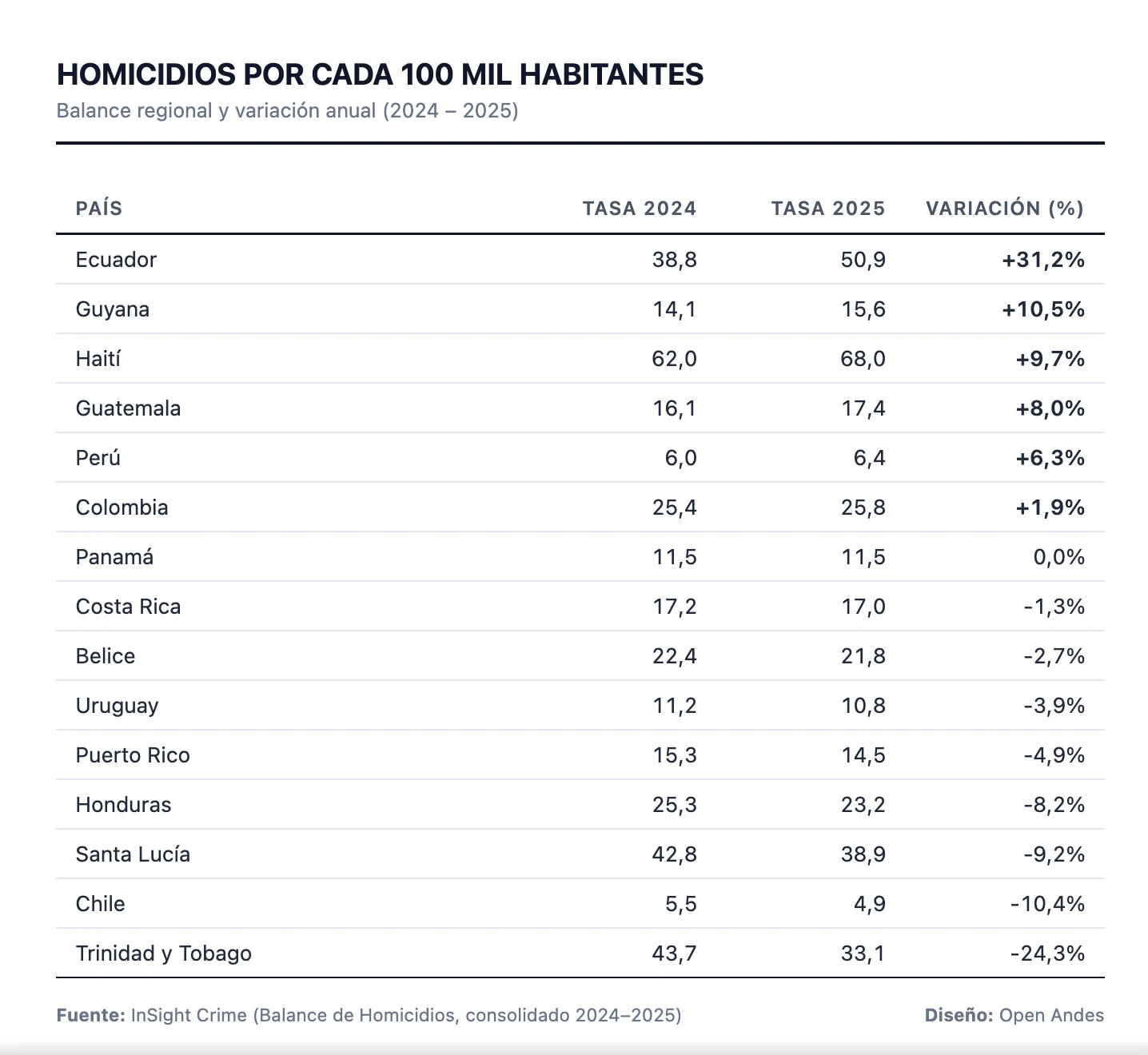
- A sustained reduction of more than 60% in the rate of homicides with characteristics of contract killing, kidnapping, or score-settling in the regions of Arica y Parinacota, Tarapacá, and Antofagasta, which would indicate a real loss of TOC’s capacity for violent coercion and monopoly over local illicit economies.
- The demonstrable operational dismantling of at least three higher-level transnational logistics networks (excluding minor urban operational cells), empirically certified by the total interruption of their supply routes for chemical precursors and cocaine hydrochloride at the altiplano border, validated by intelligence reports from regional institutional security nodes or international agencies.
Notes
- Will Freeman, “The Organized Crime Threat to Latin American Democracies,” Council on Foreign Relations, 2024, https://www.cfr.org/articles/organized-crime-threat-latin-american-democracies.
- Vanda Felbab-Brown, “Combating Fentanyl Trafficking and Organized Crime Groups in the Americas,” Brookings Institution, 2025, https://www.brookings.edu/articles/combating-fentanyl-trafficking-and-organized-crime-groups-in-the-americas/.
- Vanda Felbab-Brown, “How Chinese Criminal Networks Fuel Illicit Markets across the Americas,” Brookings Institution, 2025, https://www.brookings.edu/articles/how-chinese-criminal-networks-fuel-illicit-markets-across-the-americas/.
- Freeman, “Organized Crime Threat.”
Valentina Cid A. es Trabajadora Social y candidata a Magíster en Seguridad, Defensa y Relaciones Internacionales (ANEPE) y en Prevención, Seguridad Urbana y Política Criminal (UAH). Cuenta con diplomados en Investigación del Crimen Organizado, Criminología y Análisis del Comportamiento Delictivo. Se ha desempeñado en la Subsecretaría de Prevención del Delito y en direcciones de seguridad pública municipal (Iquique, Peñalolén, Alto Hospicio), especializándose en análisis territorial, inteligencia vecinal y gestión de crisis. En Open Andes investiga sobre crimen organizado transnacional, seguridad fronteriza y políticas de prevención.
Nota editorial
Este trabajo representa exclusivamente las opiniones del autor o autores. Open Andes es un think tank y editorial independiente, y no adopta posturas institucionales sobre asuntos de política pública.
SHARE KNOWLEDGE