 OPEN ANDES
Partial Sovereignty and Real Growth in Indonesia
Indonesia is one of the most unusual countries in the world: it has more than 17,000 islands, stretches more than 5,200 km from east to west —more than the continental United States—, is home to more than 288 million people, and its largest island is almost unpopulated.
First, why does less than 2% of the population live in Western New Guinea when more than 150 million are on Java? The answer may be demographic, a second reading economic, and a third, purely geographic. Yet despite the hostile geography, Indonesia will grow 5% in 2026 and 5.1% in 2027, according to the IMF,1 while Latin America and the Caribbean will grow 2.4% and 2.7%.2 The region holds almost half of the world’s lithium reserves and about 35% of its copper, according to the IDB,3 and it does not figure in that conversation.
What Indonesia Has
Java has more than 150 million people in barely 128,000 km², a territory smaller than the state of New York. Western New Guinea, at 418,000 km², almost the same as California, is practically empty. The difference is not only one of surface area. Java sits atop a subduction zone that covers it in fertile volcanic ash; Western New Guinea rests on the old, stable crust of the Australian plate, without those soils. Clearing jungle to plant rice is of little use there. The Maoke Mountains exceed 4,800 meters, the highest insular mountain range in the world.
For centuries Indonesia’s western islands lay on the Strait of Malacca, Asia’s busiest trade route. New Guinea was left on the margins of that. No ship laden with spices detoured there. The transmigration program later brought millions of poor Javanese farmers to the outer islands. In Western New Guinea it failed on poor soils and difficult topography, and provoked violent friction with the Papuans, a conflict that persists to this day.
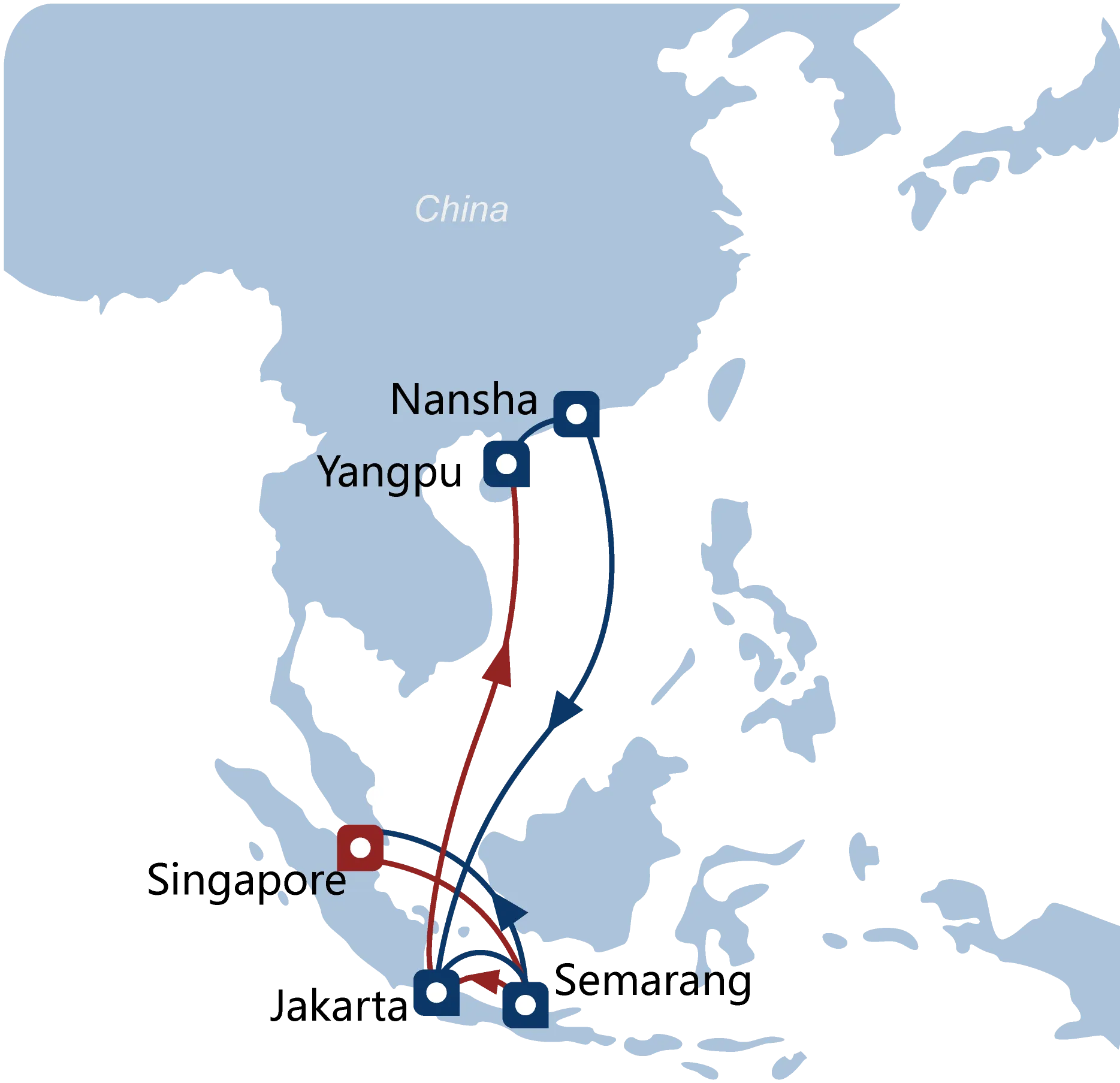
Indonesia’s maritime trade routes.
Latin America and Indonesia
Jakarta, meanwhile, is reaching its limit. The relocation of the capital to Nusantara, a project of some US$32 billion, saw its authority’s budget fall from some US$2.6 billion in 2024 to barely US$387 million in 2026.4 The government closed 2025 with a deficit of 2.92% of GDP, hundredths of a point below the legal cap of 3%.5
Latin America has its own version of the pattern. Peru’s 2025 census counted 34,157,732 inhabitants,6 of whom Metropolitan Lima concentrates 29.7% and the coast 58.7%.7 A dense coastal core and an interior that refuses to be populated describe Jakarta and also Lima.
Today the Indonesian government has largely accepted what the land allows. In the treacherous highlands of Western New Guinea, with no roads or pipelines to connect people, engineers have brutally carved the Grasberg mine into a summit, one of the largest gold and copper mines in the world. All infrastructure exists to carry the mineral to the coast as fast as possible.
Jurisdiction for Jakarta, commercial decision for Beijing.
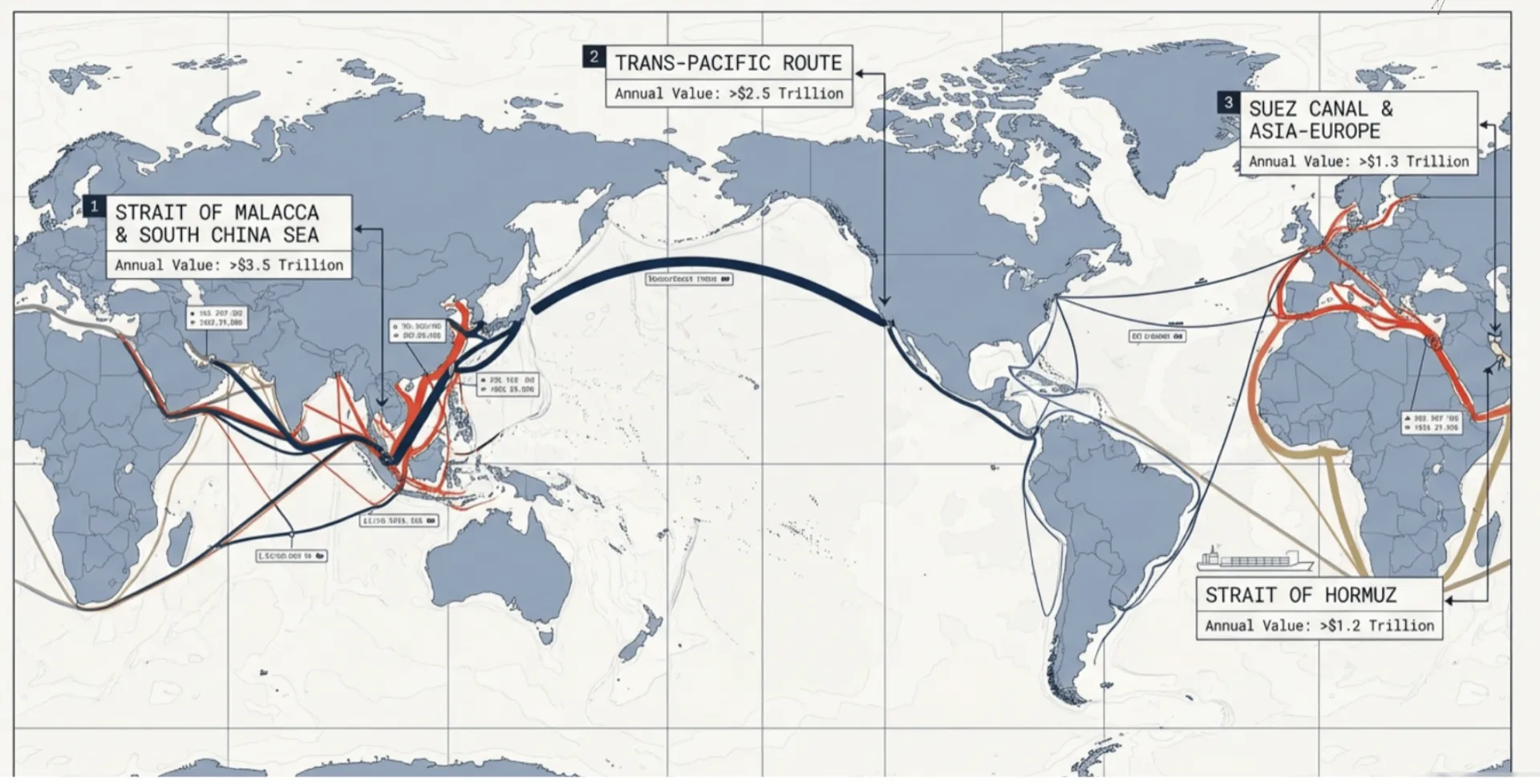
Among the world’s main maritime chokepoints, the Strait of Malacca stands out, where Indonesia is a protagonist.
That extraction is in the hands of large Indonesian state entities, which control 51.24% of PT Freeport Indonesia; the U.S. corporation Freeport-McMoRan retains the rest until 2041 under the memorandum signed with the government in February 2026.8 A mudslide in September 2025 killed seven workers and paralyzed the main block; even so, the company projects operating at about 65% of capacity in the second half of 2026 and reaching full production toward the end of 2027.9
Downstream, the same logic operates, though with a different actor. Indonesia supplies about 62% of the nickel extracted on the planet.10 Jakarta bans exporting it raw and sets quotas to force it to be processed domestically. But those who ended up keeping the refining were Chinese companies, which operate within the territory and under Indonesian jurisdiction —there is no dispute there—, though it is their capital that decides, in practice, how much goes to market and when: at least 75% of refining capacity is under Chinese control.11
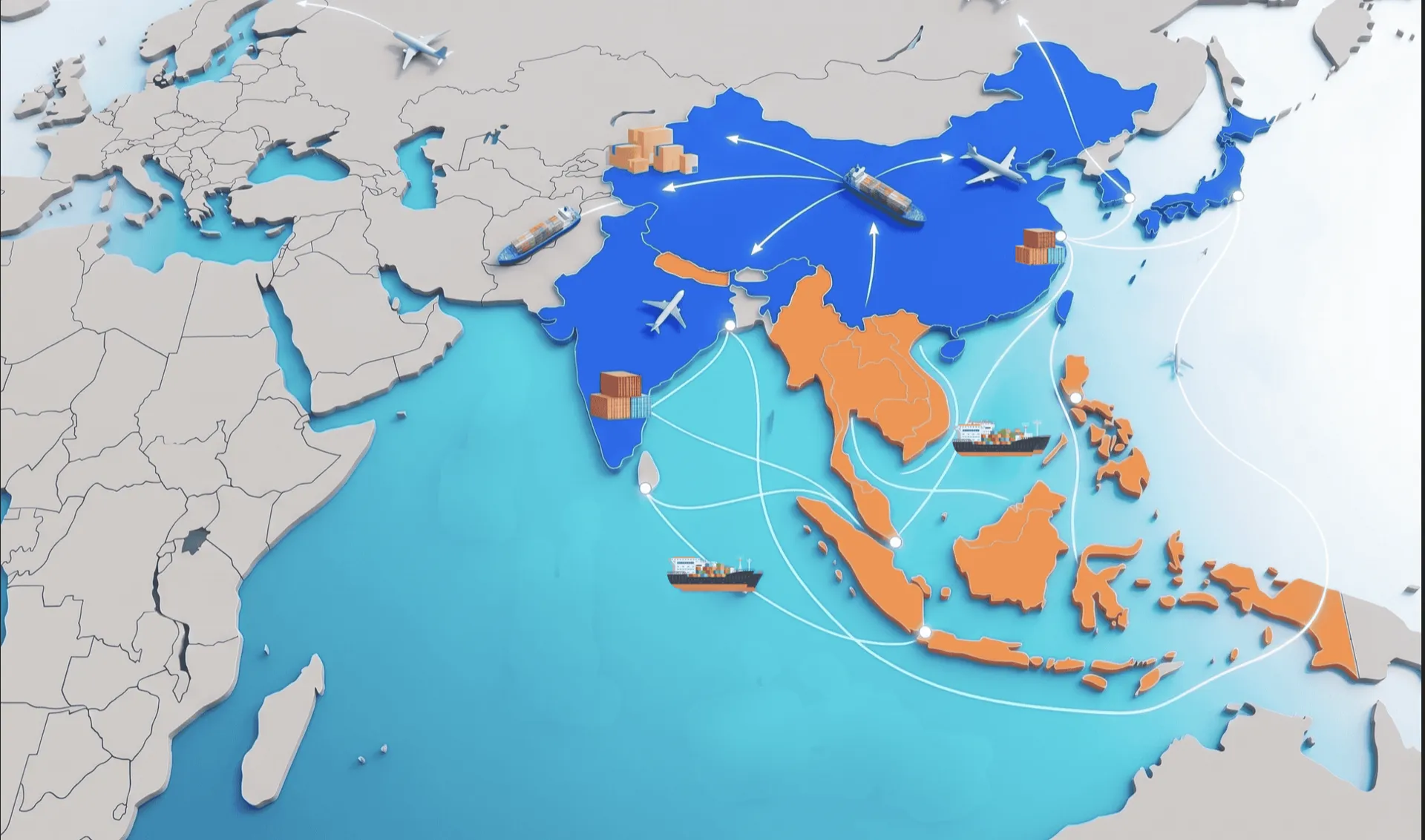
Intra-Asia logistics and trade.
In an attempt to populate southern Papua, the State declared a 481,000-hectare estate in Wanam a national strategic project: rice, cane ethanol, cassava, palm biodiesel, with participation from the Ministry of Defense.12
Latin America offers other conditions. Argentina grants legal, exchange-rate and fiscal stability for 30 years to projects of more than 200 million dollars, and under that regime Ganfeng built a lithium chloride plant in Salta, some 980 million dollars of investment.13 The processing capital, unlike in Indonesia, is in the country. What is not there is control: in Cauchari-Olaroz the province, through JEMSE, holds 8.5% of the project.14 Compare that with the 51.24% the Indonesian State retains in Freeport.
Bolivia has, by estimates, the largest lithium resources on the planet, and there Chinese actors enter through joint ventures, conditioned on legal reforms that have yet to be completed.15 It has served it little so far: the IMF projects a contraction of 3.3% for 2026.16 Chile chose another path: indirect equity participation by Chinese capital, as in SQM.17 And Brazil, the most recent case and the one closest to the Indonesian model, took a step in September: on the 16th of that month Lula signed the National Policy on Critical and Strategic Minerals, with a council created by decree to coordinate it.18 The text aims at domestic processing, traceability, state control.19 Brazil has almost a quarter of the world’s rare earth reserves and in 2025 produced barely 0.5% of global supply.20 It remains to be seen whether that translates into something similar to what Jakarta did: for now the available coverage describes incentives for processing, not a ban on exporting raw mineral.
Strategic Inference
Indonesia achieved something specific: that the State, not the market, sets the conditions under which capital processes its mineral. It bans exporting it raw, imposes quotas, retains the majority stake in one of the largest copper and gold mines on the planet. Its 5% annual growth is the margin of a host that negotiates with the capital that processes its mineral —not the margin of one who owns that chain.
Its hypothesis has a visible ceiling. Bappenas calculated that the country needs to grow on average 6% annually between 2025 and 2045 to reach high income;21 the IMF projects 5.0% and 5.1% for 2026 and 2027.
In Latin America, the processing capital is already present and the conditions are set by the investor. If by 2035 no country manages to impose local processing conditions at some mineral node, the region will be ratified as a supplier of raw material without real negotiating capacity, whoever wins the energy transition.
The thesis fails if Indonesia sustains the ban on exporting raw mineral and the extraction quotas and nonetheless grows below 5% on a sustained basis through 2030, or if Chinese capital manages to renegotiate the conditions without Jakarta retaining jurisdiction. It also fails if a Latin American country imposes local processing conditions on lithium or copper —not just equity participation— and its growth does not exceed, for five years, the regional average.
Nicolás H. Pinzón es Senior Manager en Strategy& y Strategic Advisor en 2050 Futures Lab. Graduado del London School of Economics (LSE), con formación en estudios asiáticos en City University of Hong Kong y experiencia internacional en Europa, Asia y América Latina. Su trabajo analiza la economía política de los minerales críticos y las cadenas de procesamiento en el Sudeste Asiático. Es colaborador de Open Andes.
Bibliografía
- Fondo Monetario Internacional, World Economic Outlook, actualización de julio de 2026.
- Fondo Monetario Internacional, World Economic Outlook, julio de 2026.
- Banco Interamericano de Desarrollo, citado en "Una nueva potencia minera: el mapa del BID," Bloomberg Línea, 2026.
- "Indonesia allocates Rp6.26 trillion for IKN in 2026, down from previous years," Indonesia Business Post, 2026.
- OCBC, Indonesia 2025 Fiscal Deficit, 9 de enero de 2026.
- Instituto Nacional de Estadística e Informática (INEI), Censos Nacionales 2025.
- INEI, "Censos Nacionales 2025: Lima Metropolitana continúa siendo la provincia más poblada."
- Freeport-McMoRan, comunicado corporativo, 18 de febrero de 2026.
- "Freeport says Grasberg on track for full production by end of 2027," Mining.com, 2026; confirmado en Kitco, 11 de mayo de 2026.
- U.S. Geological Survey, National Minerals Information Center: Indonesia, 2024.
- C4ADS, "Refining Power," 4 de febrero de 2025.
- Kementerian Pertahanan (Indonesia); Kontan, cobertura del proyecto Wanam-Merauke, 2025.
- Joaquín Vigueras, "El Estrecho de Malaca se resuelve en Salta," Open Andes, 8 de septiembre de 2026, citando Secretaría de Minería de la Nación (Argentina), 12 de febrero de 2025.
- Lithium Argentina AG, comunicado sobre composición accionaria de Cauchari-Olaroz, citado en Vigueras, "El Estrecho de Malaca."
- "Resource Nationalism in the Lithium Triangle," International Review, 2025; "Lithium Monopoly in the Making," Geopolitical Monitor, 2025.
- Fondo Monetario Internacional, estimación de abril de 2026.
- "Resource Nationalism in the Lithium Triangle," International Review, 2025.
- "Brasil cria política para ampliar produção de minerais críticos," Agência Brasil, 17 de septiembre de 2026.
- Agencia del Senado de Brasil, citada en mch.cl, 2026.
- "Lula impulsa en el Senado brasileño la aprobación de un proyecto de ley sobre minerales críticos," Industrial Info Resources, 2026.
- "Bappenas butuh pertumbuhan ekonomi 6% per tahun untuk capai high income 2045," Kontan, 2026.
Nota editorial
Este trabajo representa exclusivamente las opiniones del autor o autores. Open Andes es un think tank y editorial independiente, y no adopta posturas institucionales sobre asuntos de política pública.
SHARE KNOWLEDGE