 OPEN ANDES
Who Gets Heard in Chile
The strikes by guilds such as cargo transporters and the social demands crossing Chile once again raise an open question from the social uprising that began in October 2019, known in the country as the “estallido social”: why do some mobilizations seem to find greater political recognition than others, and what has happened to the structural demands that then mobilized millions of citizens?
The estallido cannot be explained solely by the 30 Chilean peso increase (CLP; about 4 US cents at the exchange rate of the time) in the Santiago Metro fare that triggered it. It expressed a malaise accumulated over decades in the face of economic inequalities, insufficient pensions, difficulties in accessing healthcare, educational debt, and the perception that institutions responded unequally to the population’s needs.
Those mobilizations, which extended through 2020, called into question not only specific public policies but also the relationships between citizens, the market, and the State. Their message transcended sectoral demands: it questioned living conditions and the distribution of opportunities in Chilean society.
With the passage of time, it would be incorrect to claim that nothing has changed. Chilean pensions depend fundamentally on individual savings accounts managed by private entities, a design whose insufficiency was at the center of the 2019 malaise. The 2025 pension reform introduced new employer contributions, a social insurance component, and a gradual increase in the Universal Guaranteed Pension (PGU), the non-contributory state benefit that complements the pension of most older adults.[1] This increase is applied in stages by age: it began in 2025 with people aged 82 or older, reached those aged 75 or older in September 2026, with a maximum amount of 250,275 Chilean pesos (CLP; about 250 US dollars) per month,[2] and will extend to those aged 65 or older in 2027. These are relevant advances, although the sufficiency of pensions remains a legitimate concern.
In public health, we find results that also require a balanced reading. In Chile, a set of pathologies is covered by the Explicit Health Guarantees (GES), which set maximum care deadlines by law; the rest of the services are called “Non-GES” and lack that guarantee. During the second quarter of 2026, pending Non-GES medical consultations decreased by 7% compared to the same period in 2025. However, pending Non-GES surgical interventions increased by 15.3%, reaching 475,553.[3] These figures show that advances in health management can coexist with persistent difficulties in timely access to medical care.

Territorial inequality is a third example. The National Socioeconomic Characterization Survey (Casen), the country’s main official measurement of poverty and income, indicates that multidimensional poverty decreased from an estimated 20% in 2022 to 17.7% in 2024. This indicator measures not only income but also deprivations in five dimensions: education, health, work and social security, housing and environment, and networks and social cohesion. The 2024 figure was calculated with a more demanding methodology, so the comparison with 2022 requires recalculating the previous series.[4] Differences between regions remain wide: Tarapacá, in the far north, has one of the highest multidimensional rates in the country, around 22%, and income poverty ranges from 9.9% in Magallanes, in the far south, to 28.6% in La Araucanía.[5] These differences remind us that well-being opportunities continue to be conditioned by the territory where people live. Recognizing advances does not mean ignoring pending gaps.
In this scenario, the mobilizations of truckers, workers, students, and territorial organizations should not be interpreted as completely isolated phenomena. Although their demands and economic conditions are different, they express the difficulties of different actors in obtaining satisfactory responses through the usual institutional channels.
Truckers have as much right to mobilize as teachers, health workers, students, or indigenous communities. But that right does not make them a privileged guild nor does it exempt them from the responsibilities that correspond to any social actor.
This statement requires distinguishing two fundamental questions: the legitimacy of the right to demonstrate and the responsibility regarding the forms that a protest takes. Interrupting roads, paralyzing services, or affecting economic activities generates consequences that must be evaluated using consistent criteria, regardless of who the protagonists are.
During the 2019 social uprising, much of the public debate focused on violence, material damage, and the need to restore order. Without ignoring those events, it is also not appropriate to forget the serious human rights violations documented during that period[6] or to reduce social demands to the most conflictive episodes of the mobilizations.
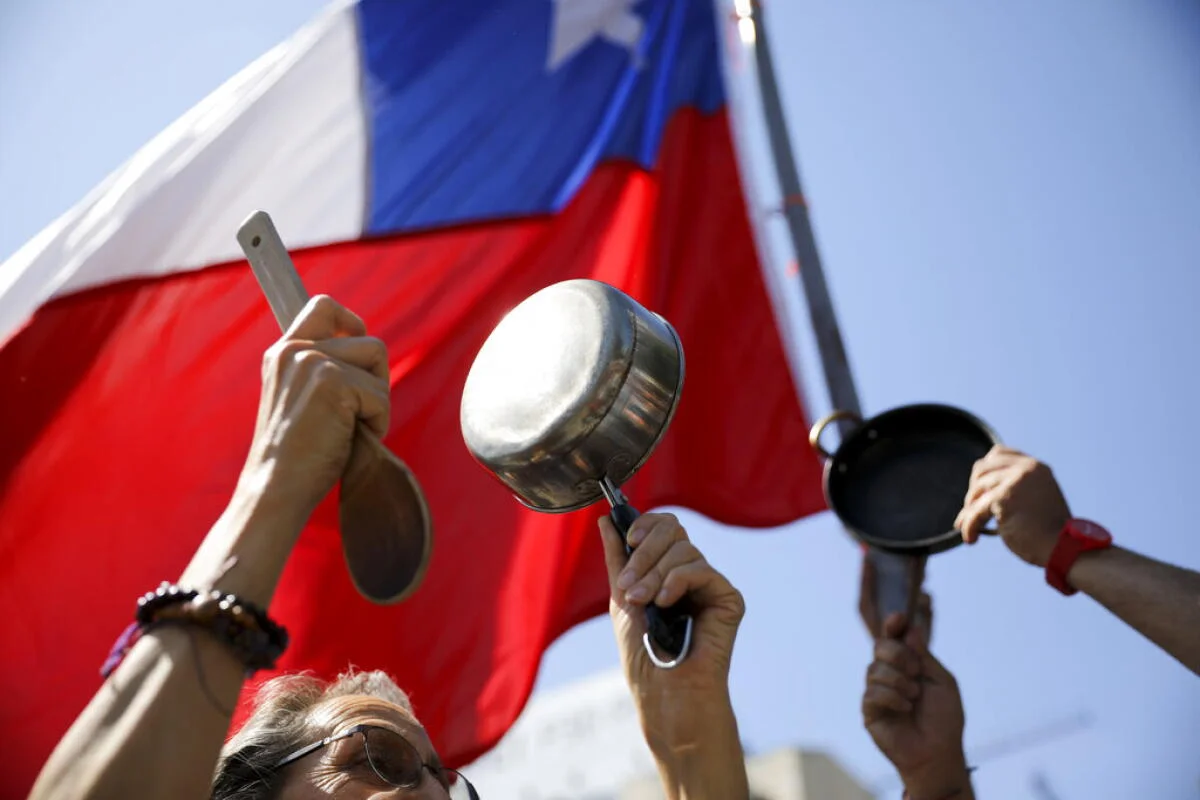
It is worth clarifying a possible interpretation here: analyzing the causes and consequences of the October 2019 social uprising does not mean vindicating the so-called “octubrismo” —a term used in Chilean political debate, usually by its critics, to refer to positions that defend or justify the October 2019 outbreak, including its episodes of violence; those alluded to by it usually reject it as disqualifying—, nor does it mean justifying the episodes of violence, destruction, or rights violations that accompanied that process. It means recognizing that it was a historical event whose social, economic, and territorial causes deserve to be examined rigorously, regardless of the ideological positions of each observer. Confirming that many of the demands expressed then continue without fully satisfactory responses does not constitute political adherence, but rather an invitation to critically evaluate how much the country has advanced in resolving them.
Historical experience should lead us to an elementary democratic conclusion: public order cannot be used selectively to discredit certain protests, just as recognizing a legitimate demand cannot justify any form of social pressure.
From an anthropological and socio-territorial perspective, there is also a dimension that is often relegated: social actors do not participate on equal terms in negotiation processes with the State.
A large business organization, a small independent transporter from the north of the country, an indigenous community claiming its territories, or an organization of rural workers have very different capacities for representation, public visibility, and access to authorities.
Therefore, the formal equality of the right to protest must be accompanied by an understanding of the real inequalities that condition its exercise. It is not enough to recognize that everyone can demonstrate if some sectors have greater possibilities of transforming their demands into public decisions.
Here one of the central contradictions of our development model appears. When certain business sectors face economic difficulties, they legitimately turn to the State to request regulation, protection, or support measures. However, similar demands for public intervention, when they come from workers, pensioners, or territorially excluded communities, can be questioned from arguments that privilege individual responsibility and market mechanisms.
The question is not to deny the need to support those facing economic difficulties, but to establish whether the principles used to justify that intervention are equally valid when those who require it belong to sectors with less capacity for influence.
The demands of October 2019 also cannot be considered resolved solely because mass mobilizations have decreased or because subsequent institutional processes did not achieve the expected results. Social problems do not necessarily disappear when they stop occupying the streets or the front pages of newspapers.
Democracy needs permanent mechanisms for participation, negotiation, and conflict resolution that allow listening both to organized sectors with greater economic power and to those facing historical conditions of exclusion.
The State’s challenge is not simply to manage mobilizations until reaching agreements that restore normality. It is to understand their causes, recognize territorial differences, and build responses capable of reducing the inequalities that fuel social conflict.
The true measure of a democracy is not only in recognizing everyone’s right to protest but in guaranteeing that the demands of those with less power are also heard and considered.
Perhaps that is one of the main lessons that Chile still has pending since October 2019: understanding that social peace is not built through the silence of demands, but through institutions capable of responding to them with justice, coherence, and a sense of equality.
Because a democratic society should not need new barricades to remember that rights, opportunities, and dignity cannot depend on who has the greatest capacity to interrupt the functioning of the country.
Notes
- Chile, Law 21,735, which reforms the pension system (2025), Library of Congress of Chile, LeyChile, https://www.bcn.cl/leychile.
- Institute of Social Security, “Increase of the Universal Guaranteed Pension (PGU),” ChileAtiende, https://www.chileatiende.gob.cl/fichas/130457-aumento-de-la-pension-garantizada-universal-pgu; Undersecretariat of Social Security, “Second group begins to receive the maximum amount of the PGU,” August 28, 2026, https://previsionsocial.gob.cl/?p=9725. The conversion to dollars was calculated using an exchange rate close to 1,000 CLP per dollar in November 2026; see “The dollar keeps rising and exceeds $1,000 prior to key US inflation data,” Emol, November 13, 2026, https://www.emol.com/noticias/Economia/2026/11/13/1216994/dolar-1000-pesos-hoy.html. The exchange rate is volatile and the dollar figure is approximate.
- Ministry of Health, Undersecretariat of Assistance Networks, Report Glosa 06: Non-GES waiting list and delayed GES opportunity guarantees, second quarter 2026 (Santiago: Minsal, 2026), https://www.minsal.cl/wp-content/uploads/2026/08/Glosa-06-LE-II-trimestre.pdf; Center for Public Policies and Innovation in Health, Universidad del Desarrollo, Waiting lists second quarter 2026 (September 2026), https://g5noticias.cl/wp-content/uploads/2026/09/Evolucion-de-las-Listas-de-Espera-en-el-Sistema-de-Salud-Chileno-Un-Analisi_20260910_110105_0000.pdf.
- Ministry of Social Development and Family, “Casen Survey 2024: poverty decreases in Chile and maintains a downward trend, with a more demanding methodology,” January 2026, https://www.desarrollosocialyfamilia.gob.cl/noticias/; “Casen 2024 shows a decrease in poverty: what methodological changes did the survey have?”, Diario y Radio Universidad de Chile, January 8, 2026, https://radio.uchile.cl/2026/01/08/casen-2024-evidencia-baja-de-la-pobreza-que-cambios-metodologicos-tuvo-la-encuesta/.
- “The other results of Casen 2024: La Araucanía is the poorest region and the gap persists in the foreign population,” Emol, January 8, 2026, https://www.emol.com/noticias/Nacional/2026/01/08/1187986/casen-resultados-graficos-pobreza-ingresos.html; “Casen Survey: despite the decrease compared to 2022, 17.3% of the population in…”, Diario Financiero, January 2026, https://www.df.cl/economia-y-politica/laboral-personas/encuesta-casen-pese-a-baja-respecto-a-2022-un-17-3-de-la-poblacion-en.
- Office of the United Nations High Commissioner for Human Rights, Report on the mission to Chile, October 30 – November 22, 2019 (Geneva: OHCHR, 2019); National Institute of Human Rights, Annual Report 2019: Situation of Human Rights in Chile (Santiago: INDH, 2019).
Bernardo Muñoz Aguilar es Doctor en Antropología de la Universidad de Tübingen, Alemania. Es director de 2050 Lab Chile, Desarrollo Sostenible & Territorio.
Nota editorial
Este trabajo representa exclusivamente las opiniones del autor o autores. Open Andes es un think tank y editorial independiente, y no adopta posturas institucionales sobre asuntos de política pública.
SHARE KNOWLEDGE