 OPEN ANDES
Beyond Chancay
Since the Multipurpose Port Terminal of Chancay began operations in November 2024, there has been speculation about the pressure on Chilean ports and the shift in trade dynamics due to regional competitiveness. Given that Peru and COSCO Shipping Ports seek to turn Chancay into a regional logistics hub, it has been assumed that Chilean ports would lose their relevance, but the responsibility does not rest solely on competition.
Port projects and investments in Chile have been outdated, and Chile lacks a comprehensive port strategy to guide the country’s objectives in that area. A study conducted by the School of International Business of the Universidad de Valparaíso (2026) identifies the main gaps in port competitiveness where Chile has opportunities for improvement, among which stand out aging infrastructure, climate vulnerability, permits that slow modernization, the Port Use Tariff (TUP), and the security of the entire logistics chain.
Although the port of Chancay is seen as a risk to the competitiveness of Chilean ports,

Huaqiangbei, Shenzhen: the world’s largest electronics market.
Competitiveness conditions
The port of San Antonio, operated by Empresa Portuaria San Antonio (EPSA), is Chile’s main port node and ranked number 100 in the ranking of the 100 most active ports in the world in 2025, transferring a total of 2,060,244 TEU with 1,025 vessel calls. Even so, other conditions reduce the efficiency and competitiveness of both the port of San Antonio and the rest of Chile’s ports.
First, in terms of port infrastructure, San Antonio has facilities that are over 100 years old and is affected by weather conditions such as swells and winds. In 2023, San Antonio recorded a berth availability of 87%, equivalent to 1,137 hours of annual closure, and although in 2024 availability rose to 91.8%, weather conditions continue to affect its operability. In addition, land congestion is an underestimated link in logistics, and in March 2025 the ASAT flow regulation system was implemented with capacity to handle up to 1,400 trucks per day, expecting to reduce congestion at the accesses by between 40% and 50%, but the security problem is added to this. Between January and October 2023, Carabineros reported 130 cases of theft of heavy trucks nationwide with characteristics of organized crime. 78% of thefts nationwide in the same year occurred on route 78 San Antonio-Santiago and on route 68 Valparaíso-Santiago. This generates problems such as waiting for safe transport schedules, which leads to accumulation of cargo at the terminals; it also generates a logistics surcharge in the increase of transport insurance premiums, and the companies themselves adopting tracking measures, security protocols and private escorts, which raises the operating costs of transport.
Second, the Port Use Tariff (TUP) is charged to vessels that use sheltered waters, and was conceived to finance the maintenance or construction of shelter works under Law No. 19,542. Currently there is no public document that standardizes the way the tariff is calculated, nor documents that make the investment of those revenues transparent. Comparatively, TUPs in Chile are competitive in the region, but auxiliary services are sometimes charged that tend to eliminate that advantage. It is necessary to establish how the 10 state-owned companies must calculate their TUP, that the calculation studies be public, and that it be mandatory for port companies to indicate the total resources collected and the destination they have had.
Finally, the permits required to modernize the system and infrastructure end up slowing the process and raising costs. There is currently Law No. 19,542 (1997), which governs state ports for public use and establishes autonomous port companies under the private concession model; and also Decree with Force of Law No. 340 (1960), which regulates private ports for public and private use. But the development of port projects in Chile requires more than 400 permits, which extends investment and execution timelines, and has caused, for example, the Puerto Exterior de San Antonio project to have been conceived in 2011, but the tender to be held in 2025. The Puerto Exterior would have partial operation from 2034, which raises the question of whether its planning will still be pertinent when it was designed two decades ago.
Chancay
Although many Chilean exporters compete with Peru in markets such as fruit, fishery products and mining, Chancay only plays a logistics role. The mega port has integrated Chilean ports into its operations, and in March 2025, COSCO launched two Feeder services with Chile. The first is “Chancay Express,” which connects the ports of Chile on the route: Chancay, Lirquén, San Antonio, Chancay, and Callao, with weekly frequency and a complete itinerary that lasts approximately two weeks. The route is operated by the vessels “Lakonia” and A. Idefix, with a total capacity of 4,272 TEUs. The second service is Chile-Perú X-Press, which began operations in December 2024 with stops at the ports of Callao, Iquique, Arica, Ilo, and Chancay, with weekly frequency. This service operates with the vessels Alioth s and Contship Don, with a total of 2,439 TEUs.
This point shows that Chile can participate in trade and integrate into the hub that is Chancay to benefit from its infrastructure and speed; however, it also implies determining a regulatory framework and specifically defining which markets are competitive and which are complemented by the Feeder service. The loss of initiative on the Chilean side may result in the role of its ports becoming subordinate to the decisions of actors that do have an action plan, in this case COSCO,
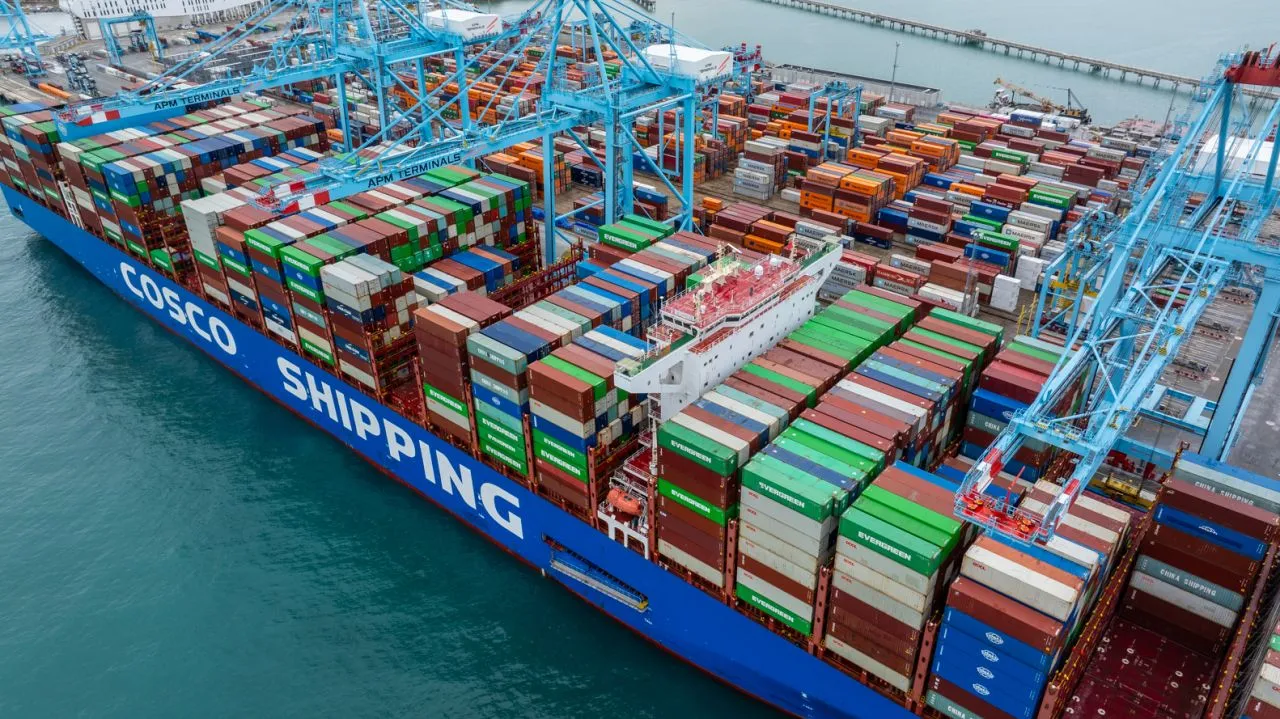
COSCO container ship in operation.
Chile’s loss of port competitiveness does not lie in the start of operations of the port of Chancay, but in the lack of a comprehensive strategy that guides the country’s objectives and enables port development. The evidence indicates that improving Chile’s competitiveness requires transformations in areas such as the modernization of port infrastructure, standardization and transparency in the calculation of TUPs, and ensuring that permits are processed in such a way that projects can be developed within the timeframe in which they were conceived. Finally, if it were achieved that (a) the Puerto Exterior de San Antonio entered into operation before 2033, (b) a regulation on the calculation of the TUP were published, or (c) port infrastructure and security were improved, and there were no improvements in Chile-Peru competitiveness, the hypothesis presented that permits, infrastructure and TUPs are the true bottlenecks for Chile would lose its support and would be weakened.
Jimena Valenzuela G. es Líder de Investigación en Open Andes. Cientista política especializada en Relaciones Internacionales y Asuntos Estratégicos, con experiencia en el Ministerio de Relaciones Exteriores de Chile y en entornos académicos. Su trabajo se centra en seguridad internacional, negociaciones multilaterales y planificación estratégica de largo plazo.
Bibliografía
- Cámara Aduanera. (2026). Perú acelera su red logística al 2032: El desafío que reconfigura la competitividad del Pacífico Sur. https://caduanera.cl/peru-acelera-su-red-logistica-al-2032-el-desafio-que-reconfigura-la-competitividad-del-pacifico-sur/
- Escuela de Negocios Internacionales, Universidad de Valparaíso. (2026). Estudio: Brechas del sistema portuario chileno (T. Pino & D. De Luca, tutoras; P. Vílchez, A. Meza, V. Villagrán, J. López, & M. Peña). Facultad de Ciencias Económicas y Administrativas. https://exporlac.cl/wp-content/uploads/2026/07/INFORME-ESTUDIO-DE-BRECHAS-PORTUARIAS-CEDEI.pdf
- Fuentes Zurita, G. (2024). Puerto Chancay y la nueva ruta de la seda. Revista de Marina, 142(1002). https://revistamarina.cl/es/articulo/puerto-chancay-y-la-nueva-ruta-de-la-seda/es
- Inostroza Sánchez, J. (2026). Opinión Cooperativa. Después de Chancay, los corredores bioceánicos. https://opinion.cooperativa.cl/opinion/transportes/despues-de-chancay-los-corredores-bioceanicos/2026-08-07/074523.html
- Villagra, M. E. (2023, actualizado 2025). Megapuerto de Chancay: Repercusiones en el comercio sudamericano e impacto geoestratégico. Revista Seguridad y Poder Terrestre, 2(2), 75-86. https://doi.org/10.56221/spt.v2i2.28
Nota editorial
Este trabajo representa exclusivamente las opiniones del autor o autores. Open Andes es un think tank y editorial independiente, y no adopta posturas institucionales sobre asuntos de política pública.
SHARE KNOWLEDGE