 OPEN ANDES
It's Not the Lithium, It's the Corridor
The conventional map of South American lithium may be leading us to look at the wrong problem. We color the salt flats of Bolivia, Chile and Argentina, calculate resources and reserves, and from that geography we infer strategic power. But that map shows where lithium is; not necessarily where power is.
The difference is not minor. According to the U.S. Geological Survey (USGS, 2026), Bolivia possesses approximately 23 million tons of identified lithium resources, while Chile has around 13 million. It is an extraordinary geological concentration in South American territory. However, the abundance of the resource does not by itself determine the capacity to transform it into industrial, technological or geoeconomic power.
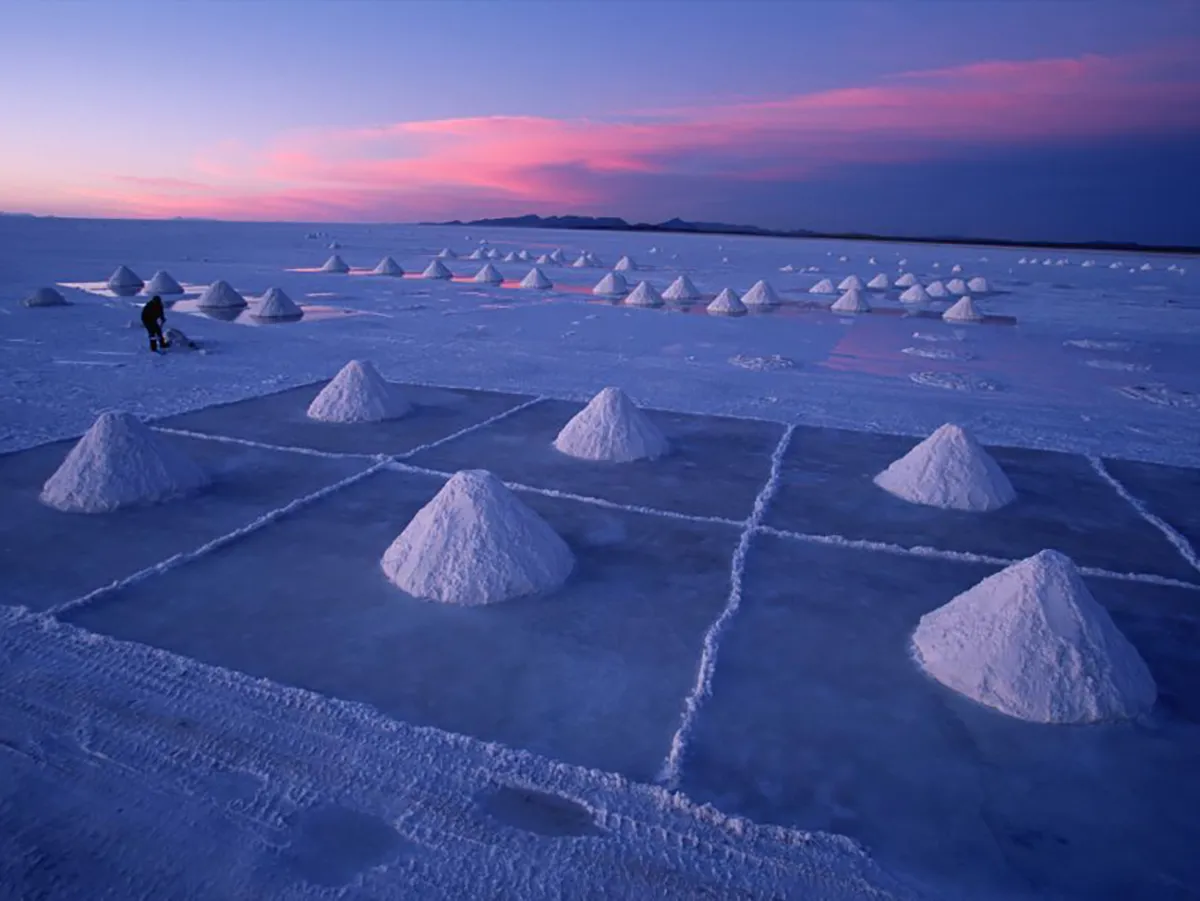
Salar de Uyuni, Bolivia.
The relevant question, then, is not only who possesses lithium. It is another: what use is possessing the resource if other actors control the infrastructure, the technologies and the industrial chains that make it possible to process it, transport it, transform it and place it in the markets that determine its value?
From geology to the value chain.
Lithium acquires strategic meaning when it ceases to be simply a resource beneath the salt flat and enters a chain that connects extraction, chemical processing, active materials, cell manufacturing, batteries, energy storage and electromobility.
And that chain is far more concentrated than the geology. The International Energy Agency (IEA) estimates that in 2024 the three leading producing countries accounted for 77% of global lithium mining, but the three leading refining countries accounted for no less than 96% of its refining. The difference between 77% and 96% contains one of the geoeconomic keys to the problem: concentration increases drastically in moving from extraction to refining. The IEA itself projects that refining concentration will remain high and places China as the dominant actor in the refining of various critical minerals.
It also makes it possible to identify concrete actors that are capturing that value. CATL, for example, reported that during 2025 it reached a 39.2% share of the global electric vehicle battery market. We are therefore not facing a simple final buyer of raw materials, but industrial actors capable of articulating technology, manufacturing, innovation and global supply chains.
South Korea and Japan, for their part, have also sought to secure positions through international investments, access to strategic minerals and development of recycling capacities, as documented by the IEA. Asia, then, cannot be understood simply as the place to which South America will export its lithium. It is a constitutive part of the industrial architecture that determines how much that lithium is worth and who captures value along the chain.
Changing the scale of the map.
This perspective allows us to observe Bolivia and Chile differently. Bolivia possesses one of the largest endowments of identified lithium resources in the world. But transforming that geological availability into competitive industrial production means simultaneously resolving technological, financial, institutional and infrastructure challenges.
The Bolivian process itself demonstrates that complexity. Yacimientos de Litio Bolivianos (YLB) has documented the use of Chinese and French technology, as well as agreements with international actors to advance in different stages of extraction and industrialization. Bolivia seeks, therefore, to increase the value captured within its territory, but that process also reveals the extent to which the contemporary industrialization of lithium depends on technologies, capital and networks that cross national borders.
Chile is a lithium producer, has extensive mining infrastructure, direct access to the Pacific and an economy historically connected to Asian markets. The conventional reading treats these situations as separate national strategies: Bolivia develops “its” lithium and Chile develops “its” lithium.
But there is another possible unit of analysis: the corridor. A corridor is not simply a road or a railway line. It is a territorial system composed of physical infrastructure, energy, processing, storage, ports, customs, regulation, security, financing, technology and relations with destination markets.
From that perspective, the question ceases to be solely how much lithium each country can produce and becomes what architecture would allow the Andean resources to be connected competitively with the industrial chains of Asia-Pacific.
This does not mean asserting that a Bolivia–Chile corridor is necessarily viable. Its economic, logistical, political, environmental and technological feasibility must be demonstrated. Precisely there lies the difference between a strategic hypothesis and a regional integration slogan. But changing the scale of the analysis allows us to discover something that national maps conceal: certain weaknesses of one territory may correspond to capacities existing in another.
Asia is not at the end of the corridor.
There is also a second cartographic error. We habitually draw an arrow that leaves South America and ends in China, South Korea or Japan. The drawing suggests that Asia is simply the destination of an export.
It is not. When the three leading countries concentrate 96% of global lithium refining, while the concentration of mining is lower, 77%, it becomes evident that the geography of power does not necessarily coincide with the geography of the resource.
Asian actors can intervene long before a shipment reaches port: through technology, investment, supply contracts, processing, infrastructure and financing. The true corridor, consequently, does not begin in Bolivia and end in Asia. It is a transnational network of interdependencies whose control is distributed in a deeply asymmetric manner. That asymmetry may end up being more important than the physical distribution of the mineral.

Cloncurryite, a rare mineral.
The map that matters.
The alternative hypothesis holds that Bolivia, Chile and other producers can autonomously develop integrated national chains and capture within their borders a growing proportion of the value. It is not a possibility to be dismissed. Bolivia is attempting to advance toward industrialization and Chile also seeks to increase the added value associated with its mineral resources.
If those processes were to reach scale, technological competitiveness and direct access to markets without depending significantly on transnational productive and logistical architectures, the thesis set out here would lose force. That is also its condition of falsification.
But as long as extraction remains geographically less concentrated than refining and the subsequent industrial stages, and as long as technology, financing and markets remain concentrated in certain international nodes, measuring the power of lithium by counting tons beneath the ground will remain insufficient. The strategic asset is not only the deposit. It is the capacity to connect territory, infrastructure, processing, technology, financing and market.
That is why we perhaps need to stop looking exclusively at the map of the salt flats and begin to observe the map of the corridors. The future of South American lithium may not be decided beneath the salt flats. It may be decided on the railway lines, in the ports, in the processing plants and in the contracts that connect, or fail to connect, the Andes with Asia-Pacific.
Bernardo Muñoz Aguilar es Doctor en Antropología de la Universidad de Tübingen, Alemania. Es director de 2050 Lab Chile, Desarrollo Sostenible & Territorio.
Nota editorial
Este trabajo representa exclusivamente las opiniones del autor o autores. Open Andes es un think tank y editorial independiente, y no adopta posturas institucionales sobre asuntos de política pública.
SHARE KNOWLEDGE