 OPEN ANDES
Silicon Valley's Achilles' Heel
At the past Davos Forum, the magnate Elon Musk remarked that few in Silicon Valley admit that the real limit on AI in the medium term will be the capacity to generate electricity, setting aside the urgency of chips, which sooner or later will end up being resolved. The world will produce more chips than it can power up, with the exception of China; one of the few countries where electricity generation is growing at a pace that barely India is approaching. In fact, nearly 10,000 terawatt hours were generated there in 2024, more than double that of the United States, with electricity demand rising 6.6% that year after 6.9% in 2023, managing to reverse what in 2005 had been an outlandish goal (China did not even reach half of it). That expansion is due to the solar and wind projects that have been completed.
Thus, China has an enormous advantage for connecting data centers. One example is the entry into operation of a 500-megawatt solar project in Ningxia. In a few months another 1,500 megawatts of wind will be added and connected directly to a data center in the city of Zhongwei, a project that is part of the national strategy requiring that data centers in the eight main regional hubs obtain at least 80% of their electricity from clean sources.
The approach is the national initiative “Data in the East, Computing in the West,” designed to move processing load from the densely populated coasts with saturated energy systems to the country’s interior, where land is abundant, the climate reduces cooling costs and there is proximity to clean generation sources. Zhongwei is the epicenter of this transformation and leverages its solar exposure and wind corridors to power the data centers that process much of the country’s information.

For the expert Kate Crawford, AI is, above all, an extractive system anchored in minerals, highly skilled labor and physical energy. That idea would explain better than any benchmark why the dispute is over the capacity to sustain them and not the training of models. In line with the above, the Chinese government believes that technological change creates economic change, which creates political change, and AI model rankings are not a priority. They prefer to position AI. In the tradition of the Shang, the Chinese are willing to make any sacrifice, provided that the new language being created is one they understand. That will be relevant.
The United States faces the opposite problem because, according to Sightline Climate, between 30% and 50% of the data center capacity scheduled to come into operation this year globally (with most of the capacity under construction located in the United States) could suffer delays, above all due to shortages of transformers, electrical panels and grid capacity.
The US electrical grid, built for the most part in the mid-20th century and fragmented across multiple regional operators, was not designed to withstand the exponential demand required by AI server farms. That is one of the reasons why, of the 16 gigawatts of capacity announced for 2026, barely 5 are effectively under construction and the rest remain at a preliminary stage, exposed to the risk that the project never takes off. Waiting times to obtain a high-capacity transformer have soared from a few months to more than three years.
Attempts have been made to qualify the impact of these moratoriums by arguing that a good portion of the affected data centers were preliminary projects and that several cases in fact continue under construction on schedules different from those announced. While the scenario is not as drastic as a headline about an isolated cancellation suggests, even with this nuance it is evident that the United States takes between twelve and eighteen months to build what China connects in weeks.
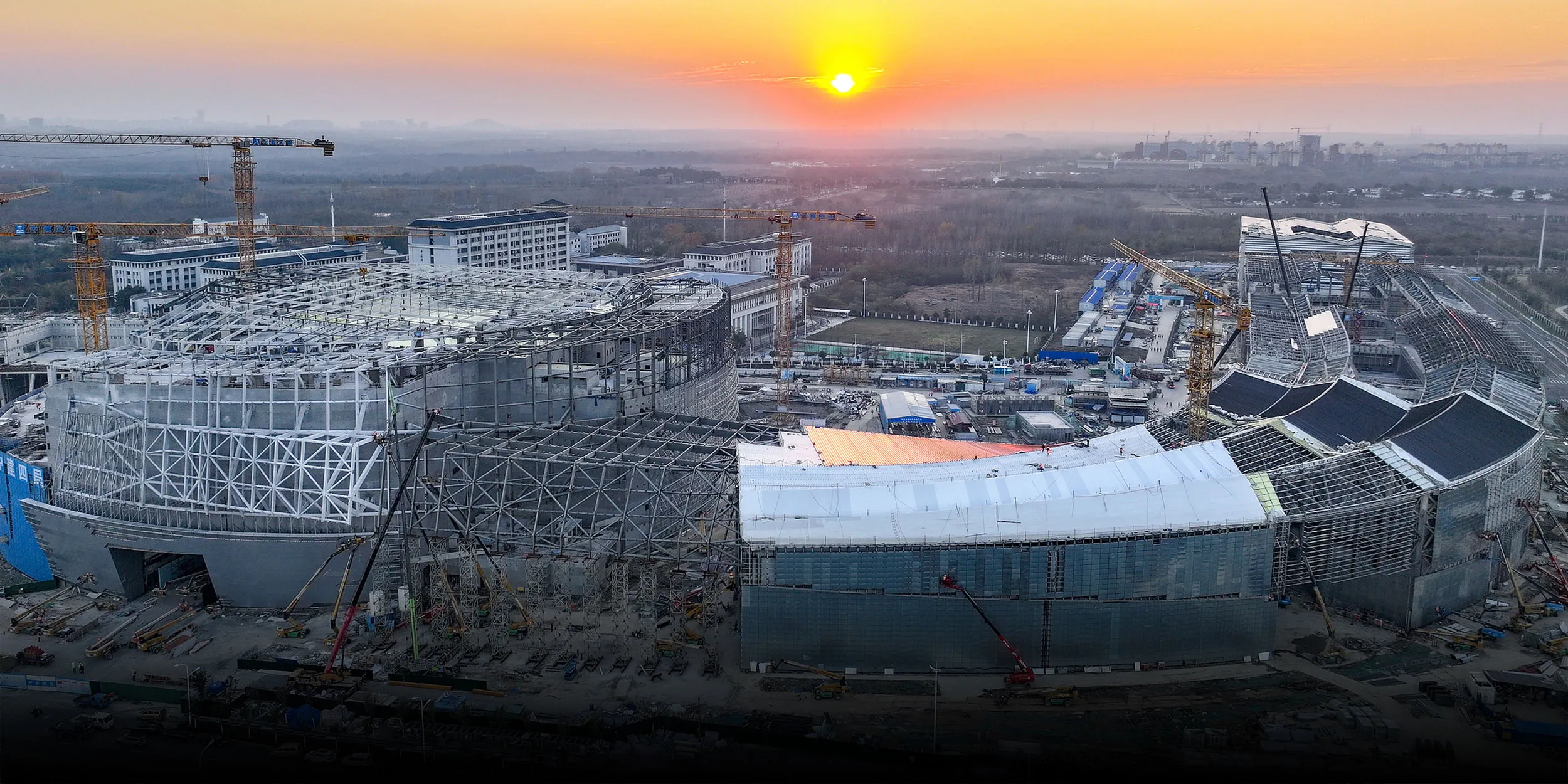
Aerial view of the Superconducting Experimental Plasma Tokamak under Construction (BEST), Hefei, Anhui, Nov. 2025.
Even so, the US and its allies (Taiwan) maintain the advantage in manufacturing the world’s most advanced chips. TSMC concentrates more than two thirds of the global manufacturing market. In China, it practically monopolizes the segment below 7 nanometers. SMIC, the largest Chinese manufacturer, fell to barely 5.1% of global share. The reason lies in the difficulties in advanced processes, but the problems are permits, transformers, community resistance and electricity demand that, over the past decade, grew barely 0.6% annually on average —although it accelerated to more than 3% in 2024 and 2025, driven precisely by AI data centers—.
The proposal, put forward by Michael Kratsios in the report he presented in July 2026 as part of the Trump administration’s “Golden Age of Science” program, is that there must be a total review, the centralized system must be adopted and ambitious proposals must be funded through “golden tickets” that do not seek consensus for approval. However, even if the US adopts the methods of China, Russia or India, it would lack the talent. By 2025, China will graduate more than 77,000 STEM PhDs and the United States barely about 40,000. If foreigners are discounted from the US count, the Chinese ratio is three to one. The United States is betting that AI will plug that hole. A short-sighted calculation.
Robert A. Hale es Lead AI Systems Architect en IBM y Foresight Data Scientist en 2050 Futures Lab. Graduado de Stanford University y de la University of Utah, Robert se especializa en arquitecturas de sistemas de IA a escala empresarial, modelado predictivo y gobernanza tecnológica.
Bibliografía
- Ember, Global Electricity Review 2026 — China's electricity demand (2024-2025) and comparison with India.
- Ember / REGlobal, Electricity Generation Trends in China and the US — historical data 2005-2024 and the 10,000 TWh figure.
- Ember, Global Electricity Review (2024-2026 series) — US electricity demand growth: 0.6% average 2015-2024, 3% in 2025.
- Counterpoint Research (via Digitimes/PhoneArena) — TSMC and SMIC market share in semiconductor manufacturing.
- Georgetown Center for Security and Emerging Technology (CSET), China is Fast Outpacing U.S. STEM PhD Growth — STEM graduate figures.
- IANS / statements by Michael Kratsios before the House Committee on Science, Space, and Technology, July 2026 — "Golden Age of Science" report and the "golden tickets" mechanism.
Nota editorial
Este trabajo representa exclusivamente las opiniones del autor o autores. Open Andes es un think tank y editorial independiente, y no adopta posturas institucionales sobre asuntos de política pública.
SHARE KNOWLEDGE