 OPEN ANDES
The Chinese Miracle of Zhou Qunfei
Zhou was born in 1970 in a farming village in Hunan, at one of the worst moments in the country’s history and in the midst of the Cultural Revolution. Her mother died when she was five years old and her father was left with damaged eyesight and missing a finger after an industrial accident. She left the village at fifteen, unable to pay school tuition, and joined hundreds of girls hired onto the long assembly lines in the fishing city of Shenzhen, then mud and unpaved streets, very far from what it would become: the city of skyscrapers, drones, high-speed trains and futuristic skylines. It was a mass migration, not an individual destiny: millions of teenagers moved down to the industrial south in those years, and the vast majority of them grew old on the assembly line, not in management and certainly not founding a company of their own. Zhou’s life consisted of extremely long days in a lens factory and, at night, studying business, accounting and technology at university. She herself has explained that it was at her job that she was able to understand the processes, the customer orders and learn how to scale a workshop. There she managed to rise within the company until she was given a management position, and at 22 Zhou decided to strike out with her own business.

With about three thousand dollars saved at today’s exchange rate, Zhou rented a small workshop, sent for eight relatives from her village and processed watch glass for four years, financed entirely with private savings and family microcredit, with no state bank involved. That model —zero regulation, zero safety net, family savings as the only capital— is the same one that explains why the anecdote works both as a story of overcoming adversity and at the same time as a portrait of a country with no cushion whatsoever for those who failed to overcome: the absence of the State that allowed Zhou’s workshop is the same absence that left any other family with nothing when the factory went bankrupt or the workplace accident arrived before fortune did. The before and after came with the first order for phone screens for TCL and, in 2003, with an order linked to Motorola’s Razr V3, a contract that catapulted Lens Technology into a leadership position, with more than one hundred million units sold. Then came HTC, Nokia, Samsung, until in 2007 Steve Jobs launched the first iPhone and transformed cover glass into an interface. Apple’s demands were so high that no manufacturer met them except the Chinese, and Lens signed with Apple an agreement that was practically a partnership, one in which Lens contributed the plant, the labor and the risk, and Apple kept the margin and the brand. By 2015, Forbes ranked Zhou as the world’s richest self-made woman.
Today Lens Technology is no longer just smartphone glass. Its annual report describes it as involved in mobile phones, computers, smart automobiles, cabins, wearables, viewers and first bets in humanoid robotics, with strategic clients such as Tesla, BMW, Mercedes, Volkswagen, Li Auto, Nio or BYD. Zhou Qunfei is no longer the businesswoman who makes screens, but a company that is moving into two of the great industrial verticals of present-day China, the smart car and robotics. But that same integration exposes the least romantic side of the fable: Lens depends on a handful of clients that concentrate most of its revenue, which makes it as powerful vis-à-vis the West as it is hostage to the purchasing decisions of Cupertino or Palo Alto.
The poor girl from the countryside, the worker by day and student by night, owner of a family workshop, industrial supplier, queen of touch glass, today a billionaire listed on the Shenzhen Stock Exchange since 2015 —and with a second listing in Hong Kong since 2025— is the symbol of Chinese development that the narrative itself needs: merit and hunger as the only explanation, the State reduced to the function of not getting in the way. Forbes calculates her fortune at 18.2 billion dollars in 2026. Deng Xiaoping justified that logic with the rang yibufen ren xian fu qilai, let some people get rich first, a phrase that served as political license for the wild capitalism of southern China and that, stripped of the individual epic, is also the formula that explains thirty years of uncompensated workplace accidents and unlimited working hours.
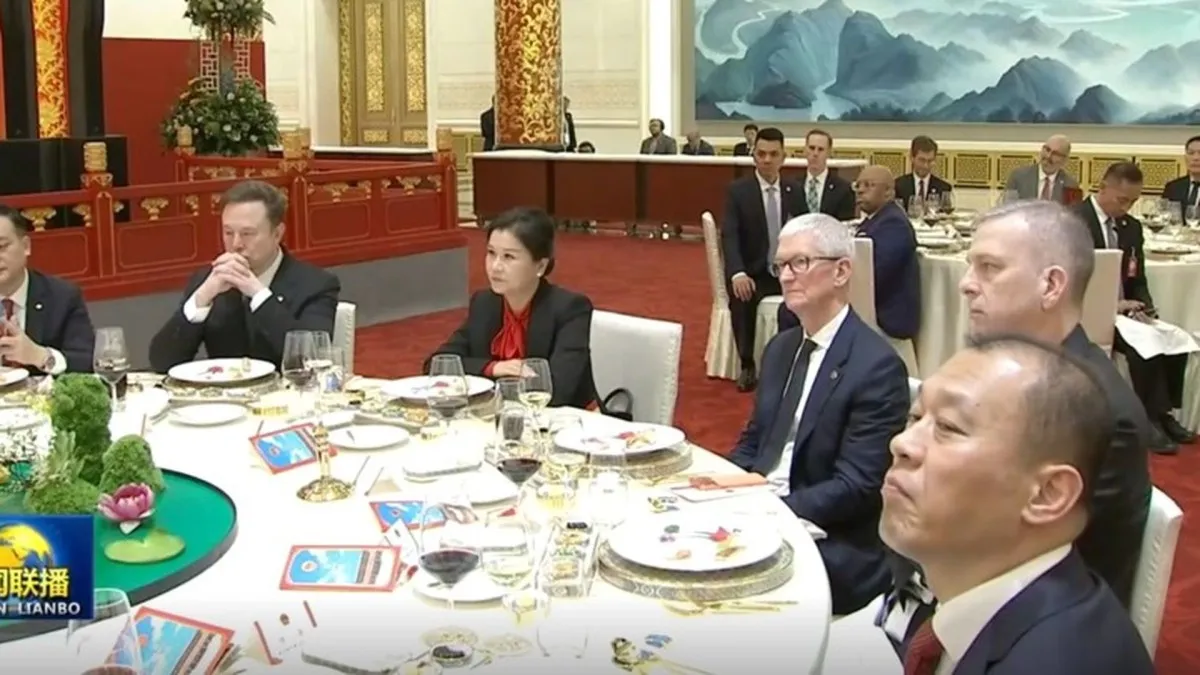
Her fame transcended the West when, at one of the dinners of the Trump–Xi summit in Beijing, she appeared seated between Elon Musk and Tim Cook, one of the few women who attended one of the star sessions where political, economic and technological power condensed in a room full of dark suits. It is tempting to believe that this is the definitive triumph of Chinese meritocracy and not to consider her as the statistical outcome, not the average, of a system that produced millions of stories identical to hers and that allowed only one in every several million to end up seated next to Musk. Zhou Qunfei, founder of Lens Technology, is the exception that the “self-made” narrative itself needs in order not to look the rule in the eye.
Nicolás H. Pinzón es Senior Manager en Strategy& y Strategic Advisor en 2050 Futures Lab. Graduado del London School of Economics (LSE), con formación en estudios asiáticos en City University of Hong Kong y experiencia internacional en Europa, Asia y América Latina. Su trabajo analiza la economía política de los minerales críticos y las cadenas de procesamiento en el Sudeste Asiático. Es colaborador de Open Andes.
Nota editorial
Este trabajo representa exclusivamente las opiniones del autor o autores. Open Andes es un think tank y editorial independiente, y no adopta posturas institucionales sobre asuntos de política pública.
SHARE KNOWLEDGE